The Winter Olympics
I Used to Be a Figure Skater, So Unfortunately, I Am Legally Required to Comment on the Olympics

Can’t lie, we ate.
Every four years, the Winter Olympics roll around, and suddenly, everyone becomes a certified figure skating expert.
“Oh, that looked good!”
“She fell.”
“I think she messed up?”
Thank you, Chad. Incredible analysis.
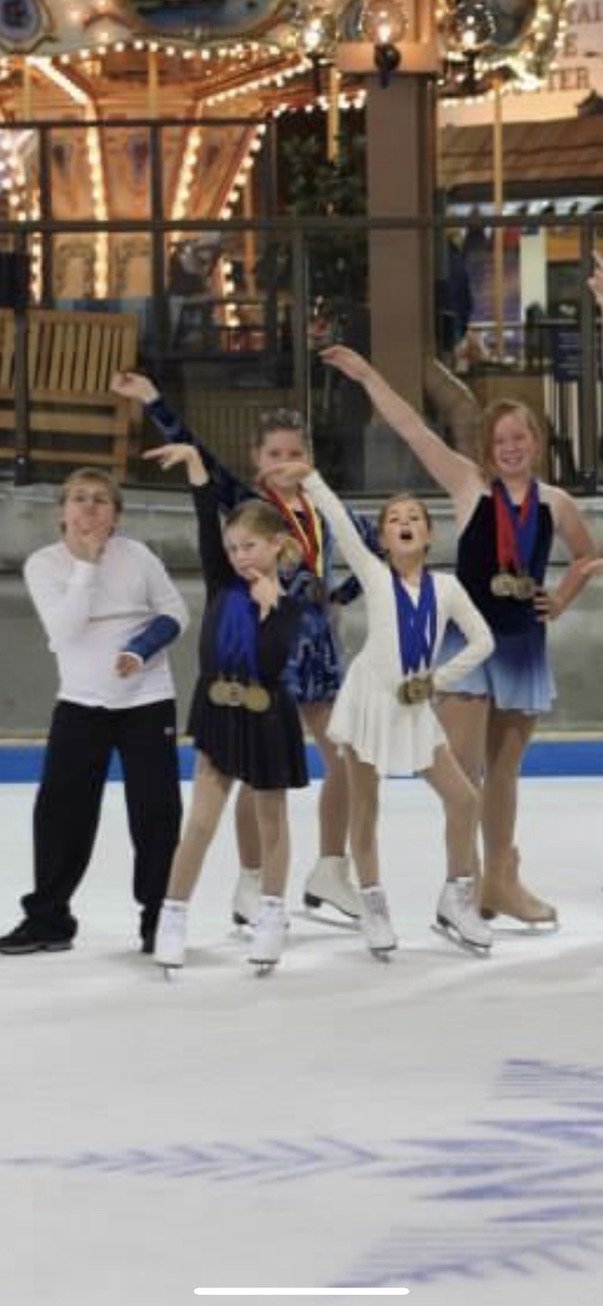
I love you forever Ober Gatlinburg Skating team
As someone who skated competitively for five years, no, I was not on a fast track to the Olympics (or anywhere close to it), but I did spend an alarming amount of my childhood covered in rhinestones, ice burns, and bruises… I feel qualified. Not anywhere close to Olympic-qualified, emotionally qualified. So here is my opinion that nobody asked for.
Figure Skating Is Actually Insane
Let’s talk about the Team USA women because they deserve hazard pay. Watching skaters like Alysa Liu, Isabeau Levito, and Amber Glenn is both inspiring and mildly destabilizing as a former competitor.
The average viewer sees:
Sparkles. Smiles. Grace. Some jumps and spins.
What I see:
Snap position. Air time. Talent I could never fathom having. (Their ankles working overtime.)
Landing a triple jump is not just “jump and spin.” You are launching yourself into the air off a blade not much thicker than dental floss, rotating at high speed, spotting your landing, and absorbing the force through one ankle like your ligaments signed a consent form.
Now add Olympic pressure.
Now add national expectation.
Now add the fact that you are 18, 20, or 22 years old, and the entire internet has opinions not only on your performance, but on every little thing about you.
Let’s start with Alysa Liu. I have a very specific kind of admiration for her. Not just because she’s technically brilliant, but because she took control of her career in a way that many young skaters rarely get to. After retiring from the sport at 16, Alyssa made the decision to come back a few years later, but on her own terms. In a sport where body image, food, and control can get very dark very quickly, she refused to let anyone starve her, shrink her, or dictate who she had to be to win.
That is power.
Figure skating has a long, complicated history with how young athletes, specifically women, are treated. So, watching Alysa compete on her terms, unapologetically herself, without the nerves and pressure of being held to a standard of perfection? Chef’s kiss. Icon behavior. Watching her perform, you can see her radiating happiness, her smooth and consistent skating reflecting her positive mindset. Her style challenges figure skating norms in the most chic way. I also will never get over the hair. ICONIC.
Alyssa’s short program at this Olympics was nothing short of incredible, and watching her skate so gracefully to Promise by Laufey was something I will likely remember in the nursing home. Her free program was absolutely stunning in every way. You can see in the way she skates that she is truly enjoying every moment out there, with no pressure on herself to medal. I truly believe that this mindset and her approach to treating her routines as an art is what won her the gold medal.
I can also imagine how special competing in these games is for Isabeau Levito, whose mom’s family is originally from Milan. Some of my fondest memories include being taken to skating practice after school by my Grandma, so my heart was touched knowing that Isabau’s grandmother only lives a few minutes away from where she would be competing on the biggest stage of her life. Her skating is also incredibly graceful, almost looking as if she’s floating across the ice. Her performance at these Olympics was beautiful. To quote my queen, Tara Lipinski, “…she casts a spell on the audience.”
And Amber Glenn. First of all, the jump height alone is enough to make me reconsider my life choices. When she’s on, she’s electric. The performance quality. The attack on her triple. The confidence. And the fact that she openly represents and advocates for the LGBTQ community in a sport that hasn’t always been the safest space? That matters. Not only is she an advocate, but Amber is the first openly queer woman to win a gold medal in figure skating, an incredible achievement that is well deserved.
Representation on Olympic ice matters.
While I wanted to mainly focus on the Blade Angels (the name the Team USA women’s team iconically deemed themselves), I can’t go without mentioning the man who does backflips on the ice for fun. Ilia Malinin, a.k.a the Quadgod, is quite honestly a freak of nature. The sheer amount of jumps this man can complete is genuinely insane, and his athleticism is incredible to watch. I aspire to do something as crazy as a backflip while moving quickly with blades on my feet, simply for aura points, too. Backflips weren’t even legal on the ice until 2024, and are still considered very dangerous.
And yes, both Amber and Ilia Malinin have had those heartbreaking Olympic moments. The small mistakes. The pops. The step-outs. The programs that didn’t quite unfold the way they’ve done a hundred times in practice.
Let me be very clear about something:
It takes an unreal level of courage to step onto Olympic ice knowing one tiny timing error can follow you in slow motion on social media for the next four years. The scoring in these competitions is incredibly sensitive, with the smallest mistake resulting in huge deductions. As seen with Amber in the short program, this sport is incredibly unforgiving, and one missed element can cause the gold to slip out of your fingers. Despite this, Amber completed a triple axel (on a scale from easy to hard, a triple axel is ultra hard) in her long program the day after, and finished her routine with such grace and determination that it pushed her from 12th to 1st.
I once forgot choreography at a local competition and had to improvise jazz hands for survival. Multiply that by a global broadcast, and I’d have likely become an unfortunate internet meme.
Ilia attempting and executing the technical content he does? Wild. The ambition alone is historic. Amber going for big elements, knowing the risk? Brave. That’s what elite sport is. You push. Sometimes you fall. Sometimes you make history.
The fact that they even have the bravery and skill to attempt what they attempt is ridiculous in the best way.
Ice Dancing: Controlled Chaos With Eye Contact
Ice dancing is what happens when you remove the jumps and add tension, precision, and extremely committed eye contact.
The twizzles (cute little spins) have to be perfectly synchronized. The step sequences require edges so clean you could eat off them. The lifts are timed down to the millisecond. If one blade is slightly off alignment, judges see it immediately.
Tracking might sound cute or romantic. I can confirm it is not cute.
Tracking is staying perfectly aligned with your partner while moving at speed, matching edges, adjusting your center of gravity in real time, and silently communicating through body pressure alone.
I did try partner skating once.
My partner was a veteran skater over 50 years old who made it incredibly easy for me. Our routine essentially consisted of us skating together, me trying to stay in sync with him, and him lifting my 10-year-old, 90 lb body like I was a sack of potatoes (if potatoes wore sequin leotards). Shoutout to Tony, a legend, king, and seasonal Grinch in our Christmas programs. He was incredibly talented and so much fun to work with. He was smooth, graceful, and kept the timing on point.
Meanwhile, my ADHD brain was like:
“Okay, focus focus focus — wait, are we supposed to turn yet — okay now I’m in the air — oh this is fast — why is this fast — smile.”
Tracking was not my strongest skill.
Olympic ice dancers make it look romantic and seamless. What it actually is? Constant micro-adjustments. Blade pressure shifts. Core engagement. Absolute trust. It’s basically telepathy in rhinestones.
And if you think that’s easy, I invite you to strap knives to your feet and make eye contact while spinning, snowboarding, skiing, and other ways to meet God.
Quick acknowledgment of the rest of the Winter Olympics.
Watching someone like Shaun White casually spin above an icy death ramp? No, thank you. Chloe Kim has all my respect, considering the bunny hill was an issue for me when I tried snowboarding.
Downhill skiers flying at highway speeds down a mountain? I would retire mid-course and ask when I can go home (assuming I would survive the first 5 seconds).
Figure skaters fall and slide.
Skiers and snowboarders fall and see their ancestors.
I personally prefer ice burns to a broken neck.
Respectfully, I will stay in the rink.
Final Thoughts From Someone Who Still Bedazzles Things
Here is the thing about the Olympics, especially in figure skating. It is not just about medals and skill. It is about audacity. It is about stepping onto Olympic ice knowing you might fall in front of the entire planet and choosing to go for the jump anyway.
Watching athletes like Alysa Liu take control of her body and her career, refusing to let anyone shrink her physically or emotionally, is powerful. Watching Amber Glenn and Ilia Malinin push technical boundaries even when the risk is public failure is brave. Watching athletes speak openly about LGBTQ+ rights and human rights while competing on one of the largest stages in the world is bigger than sport.
As a former competitive skater who once considered a clean spiral the pinnacle of human achievement, I watch all of this with awe. I know what it feels like to fall. I know what it feels like to stand up anyway. I know the smell of rink air and the sound of blades carving fresh ice before sunrise.
So yes, I will be on my couch analyzing edges like I am still paying monthly ice fees. Yes, I will defend these skaters in comment sections like I personally trained them. And yes, every time the Winter Olympics come around, a tiny, sparkly, competitive part of me wakes up.
And yes, I still could not explain the scoring to you to save my life.
